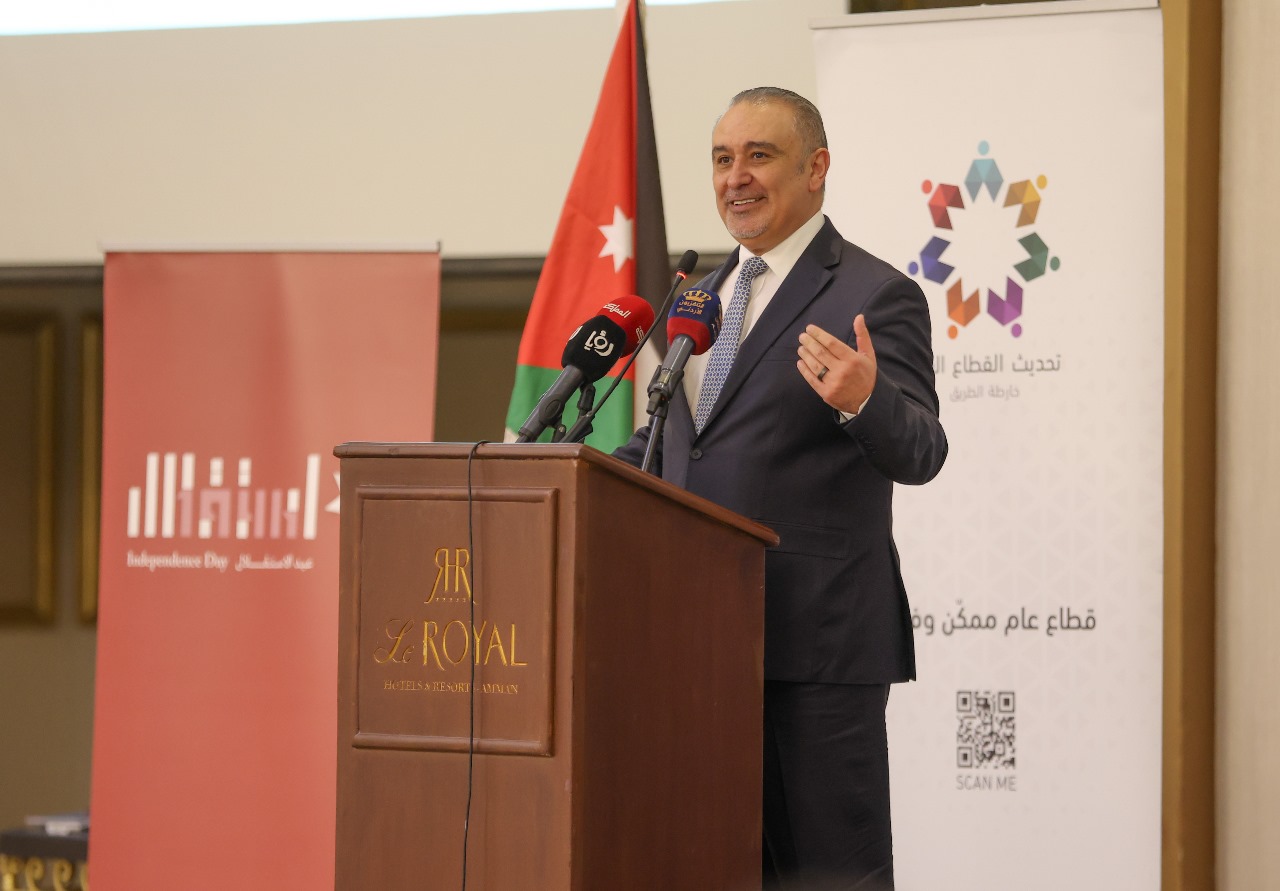
Amman, June 3 (Petra) - Heba Al-Assis - The Public Service and Administration Commission (PSAC) launched on Monday the "Capacity Building of Human Resources and Institutional Development Units in the Public Sector" project, in cooperation with the European Union, and in coordination with the Public Sector Modernization Map Management and Follow-up Unit (PMIO).
The project is being implemented to achieve the priorities of the 2024 Public Sector Modernization Map, with the aim of empowering human resources and institutional development units in government departments, and ensuring the optimal implementation of policies and standards related to modernizing the public sector.
Deputy Prime Minister for Economic Affairs and Minister of State for Public Sector Modernization Nasser Shraideh said, during his patronage of the ceremony, that the second half of this year will witness tangible results in the field of modernizing public administration, and establishing a work mechanism that contributes to achieving the desired ambition of achieving a possible, empowered and effective public sector that works to serve the nation and the citizen.
He explained that this stage is concerned with two main axes: developing individual and institutional performance, and developing services provided by the public sector, stressing that this will not be achieved without developing the human resources system.
Al-Shuraidah pointed to the role of the Civil Service and Public Administration Authority, which has sought over the past months to provide the necessary capabilities to achieve its goals, whether in the field of developing policies, standards and legislation regulating human resources work, or monitoring ministries and institutions and ensuring their compliance with these policies, in addition to providing technical support for this transitional phase.
He explained that these goals will be achieved through the Civil Service and Public Administration Authority, represented by the Technical and Advisory Support Department, which will work to empower government departments with multiple and innovative means in order to ensure the effective implementation of policies and standards; including managing competency assessment, conducting exams and interviews, quantitative and objective evaluation of jobs and other matters related to human resources management.
For his part, Chairman of the Civil Service and Public Administration Authority, Sameh Al-Nasser, said that human resources and institutional development units in government institutions play a crucial role in implementing policies and strategic plans and achieving institutional goals, as the effective performance of government institutions depends on the efficiency and capabilities of their employees who are responsible for providing high-quality public services, which contributes to achieving citizen satisfaction.
He added that developing the skills and knowledge of government sector employees contributes to improving productivity, increasing innovation, and enhancing response to surrounding challenges and variables, stressing that investing in building human resources capabilities is a strategic investment to achieve development and improve the level of government services that represent the essence of modernization and development of government performance.
Al-Nasser pointed out that the project to build the capabilities of human resources units and institutional development of government departments comes within the framework of the Commission's ongoing efforts to improve the efficiency and effectiveness of institutional units, and represents an important step towards enhancing the capabilities of human cadres to achieve advanced performance that meets the hopes of His Majesty King Abdullah II bin Al Hussein and the aspirations of citizens.
He explained that this requires secretaries-general and directors of human resources units to encourage a culture of change and continuous development for their employees by committing to training programs, and enabling them to participate in decision-making and innovation, which enhances responsibility in achieving common goals.
He pointed out the tasks assigned to the human resources and institutional development units in light of the directions approved under the human resources system in terms of merging them so that these units become the counterpart and technical arm of the Public Service and Administration Authority, as they are the most important and essential link in ensuring the accurate implementation and follow-up of all public sector outputs, and in line with the basic foundation on which the Authority is based in the centralization of policy-making, organization, guidance and control and the decentralization of implementation by ministries and departments, which the secretaries and general managers will be responsible for implementing.
Al-Nasser explained that the government was keen to translate responsibility by introducing the concept of performance agreements for the secretaries-general, so that the secretary-general’s continuation is linked to the extent of his ability to implement the targets, outputs and results assigned to his department, whether in relation to operational or development activities related to the outputs of the public sector modernization map and the strategic plan for human resources approved by the government last August, with its administrative connection to the secretaries-general.
He pointed out that the project to build the capacities of human resources and institutional development units in government departments, funded by the European Union, aims to enable the cadres of the Civil Service and Public Administration Authority and their colleagues in the human resources and institutional development units to deal with the cognitive and technical competencies related to human capital management and organizational development in all its dimensions in general.
For his part, the Executive Director of the Technical and Advisory Support Department, Dr. Yasser Al-Nsour, gave a presentation on the technical and advisory support system that the Authority will provide to government departments, most notably investing in building the capacities of human resources and institutional development units, designing guidelines, and providing innovative means of technical support that translate policies and standards into application tools based on advanced technology, which supports the shift in roles towards centralized planning and decentralized implementation.
Al-Nusour pointed out that the capacity building project will be implemented through two tracks, the first of which is in the short term, and targets a number of key areas of human resources and institutional development units in (98) departments, including competency-based human resources management, government services, strategic human resources management, and quantitative and objective job analysis. The second track is sustainability in capacity building in 2025-2026, with continuous evaluation of the impact of these programs on the work system of human resources and institutional development units in government departments.